01
Record
A finding Yu noticed that you reviewed and accepted.
How it works
Yu asks small questions, reflects back what it notices, and turns approved patterns into instructions your AI can use.

The loop
Nothing becomes an instruction until you say so. Yu offers, you decide.

01
Yu explains the idea in plain language so the next question has context.

02
You respond in your own words. Typed, spoken, short or messy is fine.
03
Yu shows what it thinks it noticed. You approve, refine or reject it.

04
Accepted patterns become instructions you can carry to your AI.
Over time
One focused topic at a time. Yu gathers repeated evidence instead of trusting a single answer, so the patterns get more precise as you go. Your assistant becomes more yours, not all at once.
Setup is quick on purpose. Your profile and a short reflection give Yu enough signal to recommend one of nine assistant models to start. From there, it customizes day by day as it learns more.
One answer can reflect a mood, a task or a bad day. Yu waits for repeated evidence and your corrections before it should get more confident.

What you leave with
Yu does not make the model smarter. It gives your AI a clearer picture of how you work.
01
A finding Yu noticed that you reviewed and accepted.
02
The written instruction Yu builds from an accepted finding.
03
All your approved instructions, gathered into one set for your AI.

One example, kept short
01 · Noticed
You stay exploratory longer than you think.
02 · Scaffolding
While I explore, expand and test ideas. When I commit, challenge assumptions.
03 · System Instructions
Joins your other approved instructions, so your AI reads them together.
Applying your Yu automatically across providers is a future direction, not a shipped integration today. For now you copy your System Instructions into the AI you use.
For the technically curious
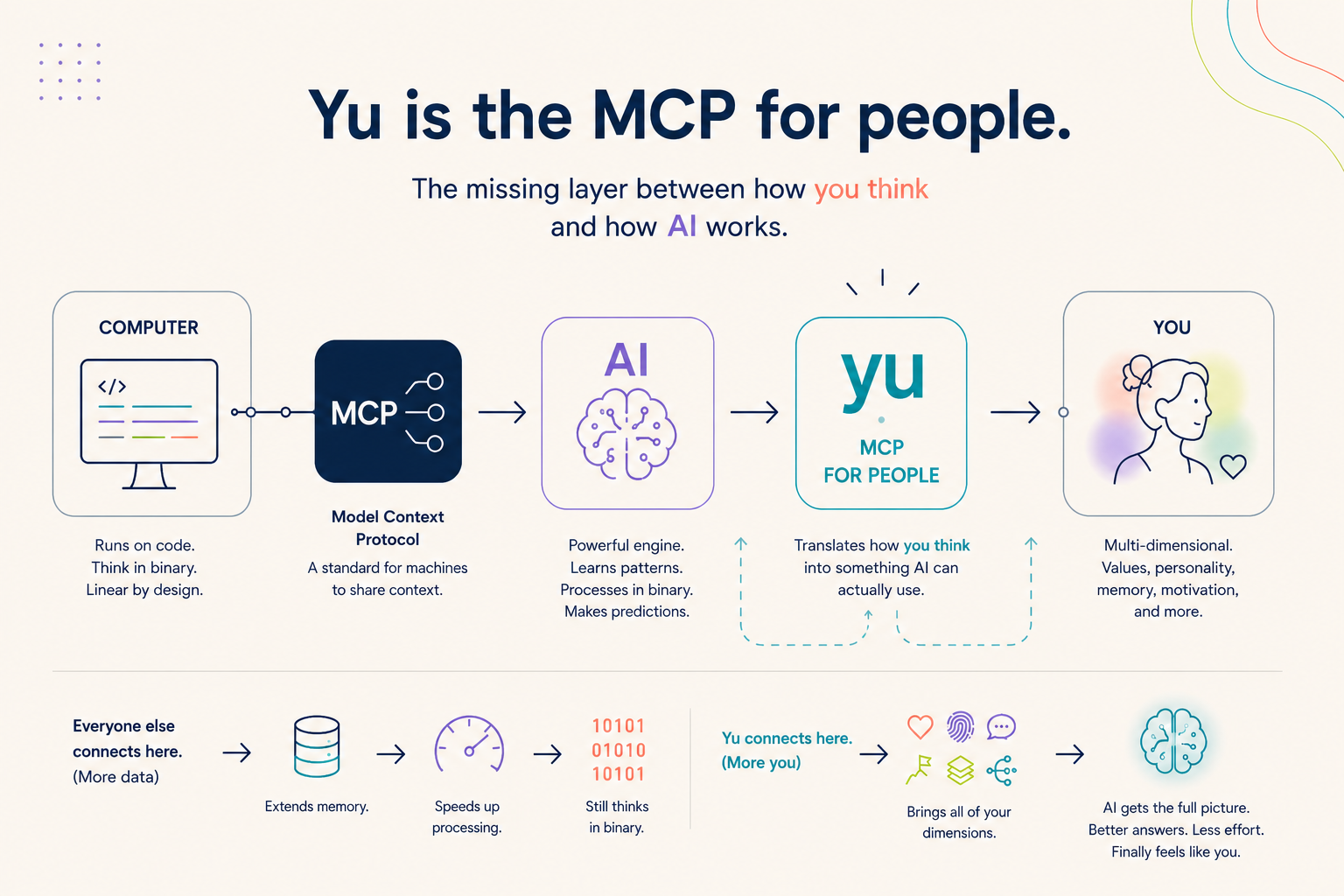
Yu explores the human side of portable context: what should travel, who gets to correct it, and who owns it.
This is an analogy, not a standards claim. Yu does not implement the Model Context Protocol. The comparison is about the role of a shared context layer.